
Breath Taken – part one
For 80000 Chilean pesos each, we book our three day trip over the border into Bolivia. This trip includes transportation through sections of Atacama, to a number of vividly coloured lakes (complete with flamboyances of Flamingos) and an epic journey across the salt flats of Salar de Uyuni. San Pedro has many companies that offer this trip, but we go with the company with the least grumpy, most informative sales representative. He is deeply Chilean, dark of skin with jet black hair. Through his intonation and the way he weaves his strong Chilean accent, there is a strangely alluring, almost hypnotic way of presenting the particulars of the trip. He hangs on to the last word in a sentence like a Chilean Kung fu master. It wins us over and we ride with Estrella tours.
The trip begins on a transfer bus that ascends quickly towards the Chile-Bolivian border. We are first to be picked up and strategically pick our seats, knowing that we will be spending the next three days with the people that we meet. We have to get this right. We sit in the middle rear seats knowing this will allow us access to any conversation in the English language. Lucy had given strict instructions to “work it” as she was feeling pretty ill with a stomach bug from the night before (Lucy’s new espadrilles being “customised” in shades of yellow and carrot.) and was really struggling to keep anything down.
We are incrementally joined by seven Australians, one South African and two French peeps who we get to know over the next few days. The Aussies are friendly and do good trade in travel stories. David and Lucy-Ann, an affluent couple just on the border of retirement, talk tales of the exotic places they visited. Places like the inside of an active volcano in Jakarta and almost being trapped in a hotel owned by an over keen transsexual (who also did the local Priscilla queen of the desert tours) desperate for business.
The other Aussies consist of jenny, Kiera and three nurses from Adelaide, Elba, Jasmin (pronounced Hasmin and frequently shortened to Has) and Rachel. The nurses like a laugh and delightfully photobomb at any opportunity to the hilarity of the group. Nobody catches the name of the French couple who are on the trip by themselves.
The bus quickly ascends into the Alto Plano mountains which serve as a natural border between Chile and Bolivia. This route entitles us to a stunning view of the Licancabur mountain. The defining point of this mountain is the natural lake in the top crater which hosts microbial life. NASA have been up there a few times to study how lifeforms can survive extreme conditions such as this on ours and on other planets.
We clock up the ascent meters quickly making it harder to breath as we progress into the journey. Our ears start to pop signifying the rate in which we climb. At the plateau, we reach another dishevelled hut with a Bolivian flag flying hard in the wind. This lonely checkpoint requires our papers and is manned by very serious Bolivian border control with guns.
Apart from the border control building, there is nothing here. No visible barriers or walls except for an interesting old bus that looks like it’s been burnt out and left on the sparse mountain range. Always looking for a unique photo opportunity I circle and approach the bus to be almost overwhelmed by the familiar stench of ammonia, realising the bus has been used by many as a toilet. The side facing away from the border comes complete with an assortment of human faeces (displaying all shades of the brown spectrum) and used toilet paper.
We eat breakfast, are divided into two groups and then bundled into two 4×4 jeeps. Our bags are tied onto the roof and covered by blue tarpaulin by our driver (Hymir I think) and we set off on our dusty route trying to absorb the stupendous landscapes on the way.
Conversation keeps on keeping on, as our 4×4 thunders through the dusty Bolivian plains. Dust flows through the seals of the car requiring regular venting from all windows and the sunroof. As we progress we realise David is a big fan of colours, “look at those colours” he says as he points at the colours. Lucy-Ann acknowledges and placates his discovery of the colours. New colours arrive and David draws our attention to those too.
Dust sticks to everything we own allowing us to create impromptu clouds by patting the most heavily affected parts of our clothes.
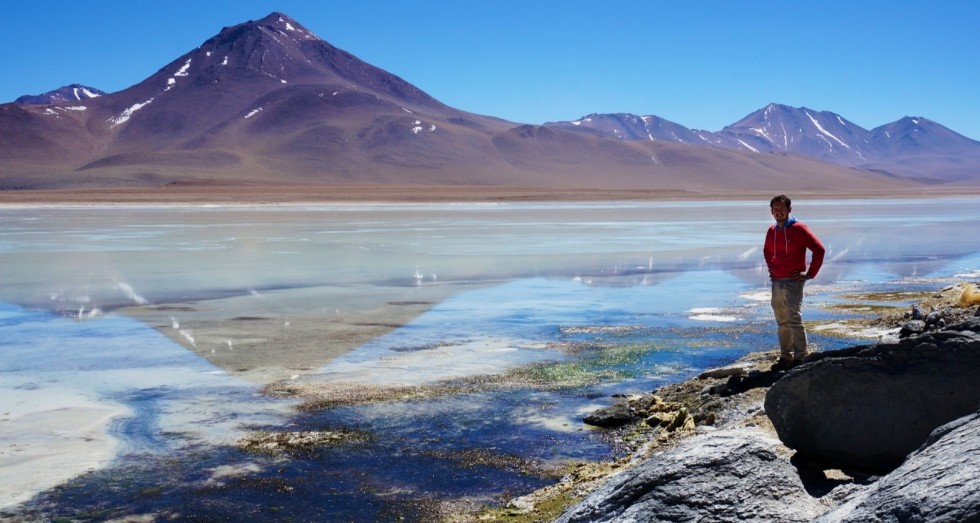
We reach innumerable, spectacular semi-frozen, green, and blue lakes, with mountains posing politely in the background for any aspiring photographers portfolio. The stunning reflections mirror the awe. Llamas and alpacas dot the route, also striking their own wooly pose whilst chewing scrub and pooing in one designated area. All llamas and alpacas apparently do this.
The ascent continues higher and higher until a number of our gang are visibly feeling the effects of the altitude. We go so high at one point we reach a bizarre ice/desert field in which sharp looking ice formations protrude out of the sand, unaffected by the sun or dryness/heat (air pressure does strange things to the freezing temperature, raising or lowering freezing points accordingly). It feels hard to manoeuvre around the formations as our hearts beat faster trying to distribute the lessening amounts of oxygen in the air.
Lightheadedness is common throughout the group and our driver begins sharing out a large bag of coca leaves for us to chew on. He chews on them too. The leaves taste disgusting, a bit like a green tea mixed with mate but we do as the locals do on this occasion. After about thirty minutes I feel I have chewed enough and perhaps due to the leaves I feel the effect of the altitude lessening.
We reach a high collection of geysers emitting sulphur with grey mud bubbling away in accompaniment. In sympathy, Lucy’s stomach bug also starts bubbling away. “Eurgh, I think I’m gonna be sick, where shall I be sick?” Lucy asks me. I briefly scan the gigantic mountain expanse in which the scale is verging on incomprehensible, an expanse in which it is an aspiration to become a blot on the landscape. “Erm, right where you are standing?” I replied. Lucy throws up right next to a deep bubbling pit of sulphurous mud. “That’ll do” I said…
We reach a top altitude of above five thousand meters which continues to make the susceptible altitude victims worse. The 4×4 jeeps stop frequently for the sick and we eventually arrive at our lodgings for lunch. Classed by the locals as a refuge, the place we stay is incredibly basic. No showers, no lights after 9.30, no hot water, no toilet paper, no heating. There is nothing within walking distance. We do get limited electricity and the many temporary residents queue for a free socket to charge phones. The base of the beds we sleep on are made of concrete. No insulation, only blankets.
In the refuge/hostel, our Australian next door neighbours (everybody needs good neighbours) are caring for their altitude sickness fallen Rachel, who is in a pretty bad way. There is talk by one of the guides to transport her to a lower altitude for safety. Alba, a Spanish speaking Aussie garners stories of people dying in the hostel due to people reacting badly and lungs filling up with fluid. Upon hearing this news the French fellow, full of empathy for the situation, gets ninety percent of the way through a tantrum and throws his weight about complaining about the predicament. Rachel thankfully overcomes the altitude sickness and makes it through the night and frenchie gets to take pretty photos of mountains.
The night is cold, really cold. As soon as the sun goes behind the desert mountains, the temperature drops rapidly. Our concrete beds thankfully have a multitude of blankets and a thick mattress, but I have to cover the window I am sleeping under with with two towels and a wind proof shell jacket. The chill blockade is secured by a small amount of Gorilla tape Lucy awesomely obtained before our trip departure. The evening meal is surprisingly good and people slowly add layers of clothing to their ensemble, some even eating soup in gloves.
Everyone goes to bed fully dressed, trying to cover up any exposed skin for fear of the cold. Most people seem to sleep really badly and all seem to receive serious headaches in the morning, our brains swelling due to the low pressure of the region. We all survive, appendages intact with no signs of frostbite and share stories of the night over a good cooked breakfast.