
Breath taken – part two
Our driver stands atop of the 4×4 and beckons us to sling the backpacks upwards to him. We oblige, load ourselves into the jeep and move on.
Our final lake, lake Colorado, holds sustenance for the flocking flamingos (ahem) in the region. A type of water based microbe/plant/algae turns the water from green to red in the sun and when digested by flamingo kind, It helps swathes of the bird to turn a vivid pinky red. The flamingos appear exotic and perhaps a little out of place in this giant expanse.
The entirety of the water is a blood red colour, standing prominently forward of the mountain peaks. We slowly stalk the closest flamingos that feed near the shoreline, trying to glacially creep close, rueing the decision not to bring a stronger zoom lens for the camera. The flamingos play it cool and saunter slowly away, knowing our footwear prevents us from transcending the dry/wet border. Taunting from afar, they scoff down on their lunch from an unreachable distance.
Ever onwards, moving on, a natural geyser heats water in a manmade pool, allowing us to change into our swim shorts and admire the landscape. Lucy passes on a dip in the pool, still feeling grotty from the stomach bug. I have to strategically change behind a hut, knowing that approaching 4x4s are “delighting” in the vision of my tidy and well groomed buttocks.
The water is a fantastic temperature, a top end bath water limit. I am joined by other travellers, English, German, Australian and we exchange small talk in terms of budgetary travelling tips and stories garnered from the opposing routes people are going in. Three recurring travellers talk about their problems with getting cash in Argentina and have Wakefield/Sheffield accents, accentuated by the backdrop of heavy Latin American dialogue. Right northern indeed.
Abor de piedra and the desert of Salvador Dali feature strangely shaped rocks that look impossibly formed and out of place in their sandy environment. We stop so far away from the latter, we can’t really appreciate the “Dali-osity” of it all. People climb all over the rocks surrounding the Abor de piedra doing their best Spider-Man in Merrell boots impression. We do the same.
We stop for lunch and hang out more with our group. At the top of the list of fun people come the Aussie nurses, Jassie, Alba and Rachel who share a laugh, dive about in front of photos and are top sports in terms of making the trip fun. Rachel does spazzy impressions of me holding the gopro pole, like a spaz. “Who am I?, Who am I?” Says Rachel, obviously feeling much better after her frolic with altitude sickness. I threaten to punch her in the face.
Our full quotient of spectacular stuff seen and done for the day, we are transported to our salt hotel. Much like most of South America, it doesn’t look much from the outside. However, upon entry we are greeted by a large modern lobby “seasoned” with pieces of salt furniture. Whilst nobody is looking, I discretely lick the walls to check we aren’t being misled. It’s definitely salt.
We get the keys to our room which comes complete with salt art adorned on the walls. Behind our double bed is a a sculpted salt headboard. Above that is a wobbly sculpted art piece, perhaps created by the work experience kid, or a local with only his left leg for an appendage. The salt stick men and the salt sun look down on us apologetically. “Sorry about us, we can’t help it” they seem to say.
The room feels like a mega luxury compared to the minimal shack hostel the night before. The bathroom is clean and most importantly private. The double bed ostentatiously brandishes a “duvet” and seems a world away from the Andean refuge the night before. Our shower throws a South American curveball and dribbles like weak sphincter, most disappointingly so.
A knock comes from the door. “Hello, do you want to play football with us?” our driver asks. We take him up on the offer thinking it would be a kick-around on the dusty ground outside the Salt hotel. He transports us to the local football ground which is equipped to host professional football matches. The gate is locked but we crawl under the fence through a large dusty gap towards the field. The pitch is full size, but thankfully we only use half of it. I kick myself for wearing jeans which become incredibly impractical for the game we play. The teams are split into equal numbers of boys and girls with me and Lucy on opposing teams. I start well, scoring quickly but the altitude destroys any stamina, pace or acceleration I might have (We still exist at around four thousand feet high). Lucy’s team have some sports fit locals (and semi-professional sporty frenchie) and put at least ten goals past any keeper we put in goal. Our team puts the effort in but our lungs aren’t capable of maintaining any kind of sprint, lacking the oxygen required to manoeuvre limbs to the speed we need.
Like an asthmatic cheetah in jeans, I am forced to lie in the foetal position, sucking at the low level of oxygen in the air. “Please make it stop. I’m dying” i say as Lucy scores time and time again. The Aussie girls laugh and jeer at our levels of fitness.
The night ends underneath a patio heater eating another surprisingly tasty meal inside the salt hotel. We manage to swop ourselves for the French couple and upgrade to the dinner table with the Aussie nurses. The connection strengthens and we compare stories of thigh strain and bruises from the football. Through conversation, it also appears everybody else’s shower had the force of an excited fire hydrant combined with the heat of a Tatio geyser. Grawwk.
The next morning, we get up at four-thirty to catch the sunrise of the Salar de Uyuni salt flats. The jeeps are loaded with gasoline and breakfast provisions for our hungry gang. The night proved to be significantly warmer than the previous but we still need to wrap up in our base layers hats and gloves.
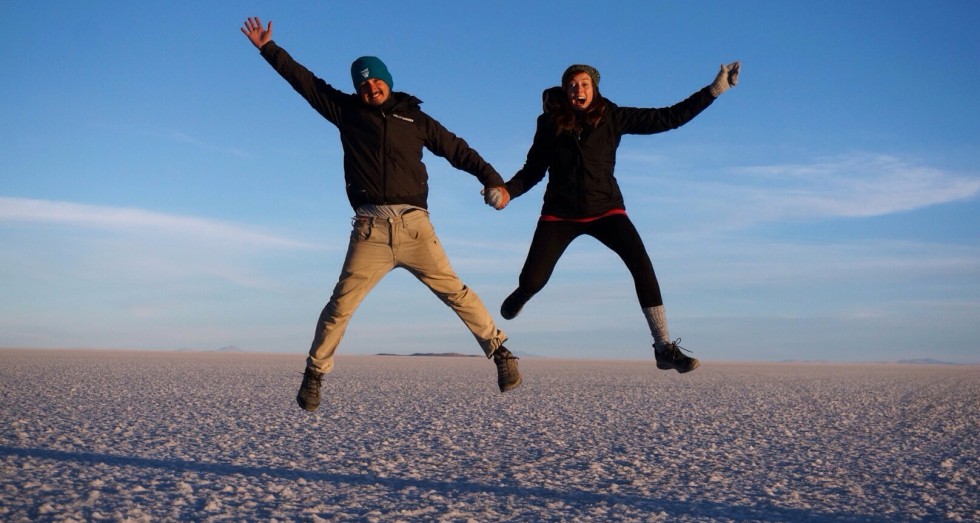
As we reach the white flatness of the salt expanse, blackness turns to red to orange, to blue. The jeep leaves no tracks here as the almost rock solid salt base stubbornly resists the off road tires. For a short time, our shadows extend what seems to be hundreds of miles and we try to capture the magnificence of the salt flats at sunrise. Throughout the day the salt remains extremely cold to touch, presumably because the whiteness deflects the heat, absorbing little in the way of the fierce sunlight above. Our footsteps make a strange, almost hollow sound as we walk atop of the compacted salt. Apart from the sound of footsteps, any conversation has a dead sound with our vocal soundwaves having little to bounce off. Shouting the word “echo” comes with no reply.
Apparently, underneath the one hundred and twenty kilometre, gargantuan salt plain lies a huge underground lake. Occasionally we tread soft moist spots verifying this to be true.
It becomes difficult to find the adjectives to describe the salt flats. They have an other-worldly quality of a barren salt planet, with no detail apart from an organic hexagonal pattern that runs across the surface. The curve of the earth is visible, almost as if someone has implanted a permanent fish eye lens into your skull. There is a grandeur of nothingness, an extreme “less is most definitely more”, in this case the mammoth scale being impossible to judge. Despite spending hours travelling in the jeeps, minuscule points of reference like distant blue mountains don’t really get any bigger, no matter how long you drive at them.
We reach a bizarre oasis of an island in a section of the salt flats. This island is dominated by large tall cacti, presumably only there for the photo opportunities. Against the whiteness of the salt, the cacti look stunning, following the curve of the salt “shore” line. We walk high into the hills of cactus island and look over the plains from a higher vantage point. Our eyes thank us personally for the visual feast, go back for seconds and consume a salty dessert desert. Yum.
The morning sun is rising now and warms the life on the island. Like a South American security guard, a few inquisitive llamas check out the influx of new tourists, then go about their business, guarding very little.
We return to the Lexus jeeps and at last reaching Uyuni, our final stop is a photographer and parkour enthusiasts dream destination. A train graveyard sits just outside the Uyuni gates with huge lines of trains stripped bare and existing in a skeletal state. The husks lie empty, devoid of their insides with parts of the trains strewn across the ground (those parts being presumably too heavy to scrap or steal). Exploring the site feels like participating in a giant robot autopsy as it becomes possible to crawl inside engine spaces, getting deep into the guts of the machine.
The carriages are adorned with Latin American graffiti and bake in the hot sun. “Bienvenidos Dakar 2014″ (the Paris to Dakar rally moves here next year). Sand and dust have migrated over the tracks leaving the trains seemingly stranded and impossibly placed. We take a walk around the graveyard but I decide a higher view would be better. Clambering up the trains and onto the roof, I do my best Indiana jones impression. Jumping from carriage to carriage trying to ignore visual rust and tetanus warnings throughout. Eventually unattached wobbling platforms underfoot, unnerve me enough to get down off the roof.
Journey complete, we swop Facebook and contact details with the rest of our companion travellers, give big hugs and wish our new found friends luck in the future. The Aussie nurses were taking a flight to la Paz and we planned to meet them there. However, we took the bus…