
Light beats night
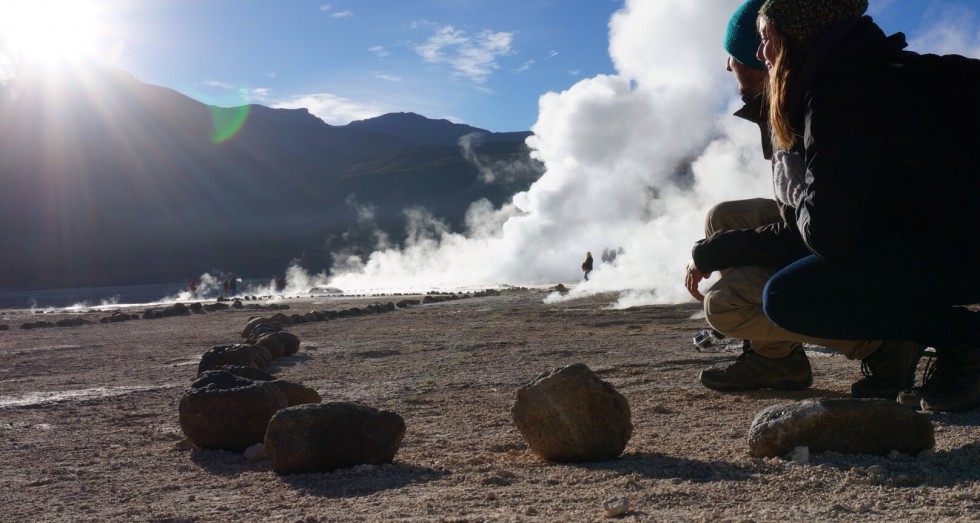
I remove my ear plugs, sensing the vibration of my alarm and we ready ourselves for our trip to the Atacaman, Tatio geothermic geysers near San Pedro in Chile.
San Pedro is an extremely dusty base camp for many landscape based tours in the Atacaman desert region. We stay at the hostel Candelaria which is an authentic adobe based collection of rooms that has a larger population of dogs and cats than backpackers in the time we spend there. Our inept immune systems are overwhelmed by the proliferation of histamines, and work overtime sneezing much to many airborne particles attaching to clothing and nostril hair.
Our host Mario is incredibly warm and cooks a mean scrambled egg that is more than appreciated by us, even bending to the request of ketchup to accompany the eggs.
The center of San Pedro is a ten minute walk from our hostel and has clearly been altered by the steady flux of tourists in the region. Signs above shop entrances have a certain conformity of design and appear to be sponsored by coca-cola and regional mobile phone companies. Shops sell a variety of tourist centric items from llama and Alpaca wool clothing, to Chilean Viagra complete with softcore porn packaging. San Pedro also heaves with adventure tour companies selling experiences to intrepid backpackers with a thirst for adventure.
A trip to Valle de la luna is both desolate and epic as the bizarre formations resemble a moon like surface. Beautiful, remote and formed over hundreds of thousands of years by wind and a minuscule six days of rain a year. The natural gypsum and salt creak in the hot desert sun sometimes appearing as a hard glassy formation. Our last stop on the tour is to Death Valley. Another harsh expanse living up to its name.
The next morning, we travel to the Tatio geysers, witnessing moonset and notice the adornment of a reddish tinge to the moon. As we travel deeper into the desert, the stars brighten leaving a breathtaking band of constellations easy to see.
The temperature steadily drops as we ascend what will eventually become a four thousand meter high ascent. What began as condensation becomes ice as it forms on the inside of the windows of our bus. We pickup an unlucky (or perhaps actually lucky) broken down tourist who bags the last empty seat on our bus, relieved to be saved. The dusty track takes a life of its own as the vibrations jar suspension and spines throughout. Night driving makes the journey seem fast but the driver navigates the mountain tracks efficiently, even though the road is stolen into the coal black night. A sporadic and occasional cats eye embedded in the road gives some clue to where sheer drops fall away from the road. No barriers or errors of judgement allowed here.
We arrive just as light beats night, to a moody field of geysers spouting steam from fissures in the earth’s crust. Where lava meets underground rivers, steam is produced and forces it’s way to the surface, boring an escape over thousands of years.
The imagery is a photographers wet dream, providing a dramatic landscape, water reflections, and unlimited steam outlets that shroud the scenery (we’re talking serious 80s, Bon Jovi music video territory here). The surrounding mountains and active volcano (the Licancabur) conveniently pose nicely for photos, pulling their best moody “band” poses too.
The geysers vary in size as the larger ones bubble, slosh and spit their steamy wares, whilst the smaller ones smoulder with heat. It is with great relief when we find a small geyser hole as I seem to be the only one not wearing a pair of gloves. The cold is incredibly painful with the average temperature at this time in the morning being around -11. I hover my hands above the surface of the small geyser and ward off frostbite for the next couple of minutes.
The guides cook hot chocolate in middle sized, hot springs and pour us the spoils into flask cups.
After breakfast we are transported a short distance to a steaming, geothermic swimming pool. We change into our swimwear (quickly) and step into the pool. The floor of the pool has multiple hot-spots in which the steam is trying to escape. This heats the water to a warmish temperature but can be painful if you step directly on to one. The overall water temperature isn’t quite warm enough to maintain a long period of time in the water, but the change back into your dry clothes would have Norris Mcwhirter diving for his stopwatch, (your towel and all your clothes take on the ambient, minus temperature of the mountains) I.e. You get dressed fast and shiver lotta, lotta.
What better way to spend a post-geothermic bathe than to gnaw on a local llama kebab? A stop at a tiny settlement and a Chilean chef is cooking on an outdoor barbecue. He daubs the kebab with the stem of a green herb, dipping frequently into a vivid green sauce. Llama is a dark meat with a flavour similar to beef. The settlement is far from the remote town of San Pedro, and appears a tough farm based existence, in the shadow of breathtaking but desolate whereabouts.
Crucifixes sit atop all of the rudimentary adobe buildings, (built from clay, mud and straw) religion bringing a seemingly simple community together.
There is so little here, again demonstrating the persistence of humanity to seek survival. A seemingly sprawling canyon between the lifestyles we know and that of the native Chilean people stretches before us. Their existence captured into 4:3 or 16:9 HD format by those that have.
(1) awesome folk have had something to say...
drnie -
October 24, 2013 at 8:08 pm
very nice adventure nan has been reading your blog and enjoys it