
‘tites and ‘mites
Catarino’s is strangely devoid of travellers. When we arise for breakfast, we realise this by the fact we eat alone from a giant cornucopia of untouched food. Multiple cakes, whole watermelons, Papaya, jugs of probiotic yoghurt type drinks, a selection of mysterious meats, cheeses, fully sliced loaves of bread, biscuits, coffee, hot chocolate, fruit teas, hot milk, bananas, sliced pineapple, ham, pizza slices and much, much more food becomes almost embarrassing as we fill our bellies but only manage to consume less than five percent of the food. Santos is around at breakfast and asks me political and economic questions about the UK. The conversation grows and he tells us about his time in São Paulo in the nineteen seventies. “It was a different time” he said. “Not as many cars as now. You can get a car so easy in Brazil, you just need a couple of hundred dollars and they’ll let you drive one away. When I first came to Bonito (after São Paulo) there were only twenty five thousand people living here, now there are three hundred thousand”. Santos continues by describing how the local government had issued multiple permits for tourism in the local area, mostly due to the clarity of the water. Bonito’s water passes through limescale rock which acts like a natural filter. According to Santos all of the impurities stick to the limescale which sinks to the bottom (riverbeds) of the water. The snorkeling is perhaps some of the best in the world due to nature’s own Brita filter in action.
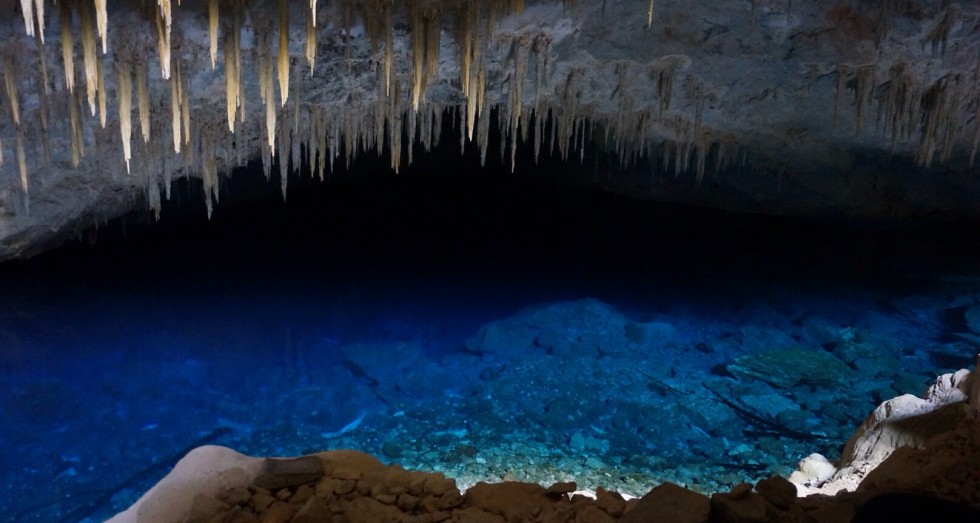
Upon recommendations from Santos and Catarino, we take a taxi trip to the Blue Lagoon caves just outside of Bonito. We pass dusty farms (fazendas) along the way, clocking the orangey yellow tracks carved by tourists exploring the area and reach the caves. We are handed a ticket for group nineteen and join a predominantly Brazillian group of tourists awaiting the descent into the mouth of the cave. Our safety instructions are in Portuguese as is the entirety of the information given to the Portuguese language speaking tourists along the way. We don our helmets (I said helmets) and follow the group into the mouth of darkness. The route into the cave is surprisingly treacherous as the well trodden steps (sort of carved up) have attained a polished exterior by previous tourists. At times the under footing feels as if somebody has been dusting the cave with a can of Pledge or Mr.sheen and we have to do our best not to fall screaming into a precipice. The interior of the cave is impressive showing off the ‘tites and ‘mites but with limited space to go wandering, we quickly reach the bottom of the path. The cave performs a couple of nifty set pieces down here, the aforementioned lime in the rock has a blueish tinge and when you reach the bottom, you can see a vivid, almost eerie blueness to the water in the base of the cave. The blue hue is somehow more pronounced in photographs and markets itself well to tourists with no need for photoshop. The other trick it pulls is from a reflection on the surface of the water in which by refraction it displays the letters L and A in an almost Saatchi designed logo. The Portuguese translation is Lagoa Azul (Blue Lagoon), well done smarty pants cave, you have it all.