
Floaters
We arrive to the overwhelming stench of poorly redirected, human sewage at Puno bus station, seemingly circa the 1960s. Puno it seems, is spelt incorrectly, “Poo-no” seems more apt given the aroma and experience the locale leaves.
We are here to transfer to the floating Uros islands (perhaps floater is a better term) which are famed for hosting an idigineous race of people that escaped the Spanish invasion by working out how to create maintainable islands in the middle of Lake Titicaca. Our bus station transfer is sloppy (a little like our interpretation of its namesake) and confusion reigns until we are put into a battered taxi that lays us at the long dock. As we board the boat, a plucky guitarist performs Beatles cover songs with a strong Peruvian accent, perhaps betting on American or European donations to put food in his table. We are relatively charmed and gift him some Peruvian soles.
The Uros Islands are numerous, totalling an impressive seventy two on the lake, but on this trip we are only allowed to see two of them. Our boat trip guide speaks volumes about the floating islands and switches between Spanish and English effortlessly but also talks incessantly without space to digest his knowledge. The delivery is difficult to engage with and arse numbing tedium sets in after a while.
The tourist boat slowly departs after a lengthy wait and meanders across the calm glassy lake. We are navigated through exposed reeds towards our destination. Our guide explains “titi” (He he, I wrote titi) means Puma and caca means “grey”. Lake Titicaca resembles the shape of a puma and was labelled grey puma by the local natives.
We disembark the boat on a tiny island which the guide calls the capital of Uros. There is no electricity in the entirety of Uros and locals are limited to occasional disparate generators and transportation via boat.
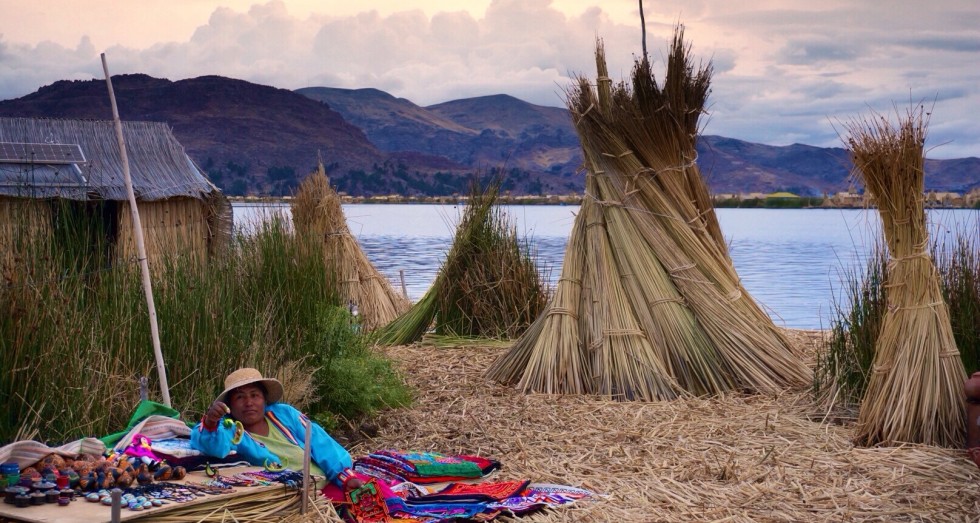
Under our feet lie multiple layers of placed reeds, which form the surface layer that is walked upon by local and touristic soles. We are given a presentation on Uros, the people and how the islands exist in their current form, as a number of curvy local ladies come out to meet us in vibrant lime green, orange and red clothing with joyful greetings in a Quechuan tongue.
Four or five straw huts sit on top of the reed base, being the show houses of locals on the island. One of the rotund ladies approaches us and beckons us into her straw house. She introduces herself as Anna and we reciprocate with our names. She has an adorable demeanour and smiles thoughout our meeting, making humorous small talk.
We have to stoop to enter the gap which serves as her front door. Anna shows us round and is extremely welcoming and hospitable. Her house is small is extremely “compact and bijou” and contains surprisingly little in the way of possessions. A bed takes up most of the space as accomplished Quechan artwork pieces of pacha mama and pacha dada hang on the straw walls.
“Did you make these?” We ask.
Anna nods and carries on smiling. We continue the conversation outside the house as Anna shows us more artworks she has made. The work is impressive with a strong graphic flair. Representations of animals showing significant symbols from the Quechuan beliefs are vibrant and we are impressed with Anna’s skills. She continues to show us her produce.
“… And you made these too?” Anna nods and smiles.
Anna pulls out a huge pile of fabric artwork pieces, wristbands, necklaces in the shape of the Andean cross.
Finally the penny drops…
We have been taken directly to the gift shop and this island only exists to sell tourist tat. Anna continues to leaf through her wares until the situation becomes embarrassing. Having just crossed the Bolivian border we have no Peruvian money to buy (and appease our guilt of not buying anything). Anna insists on showing us everything in her stack until we have to walk away.
It’s occurs to me that none of these ladies actually live on the island. These houses aren’t lived in, the clothes they are wearing are fake representations of historic Quechan clothing and these ladies are sales representatives for the Puno tourist board. We smile politely, thank Anna for her time and walk back to the boat awaiting transport to the next island. The boat’s engines accelerate, transport us at least four meters and the guide beckons us to get off onto the adjoining island.
This island’s purpose is a tourist restaurant. Again curvaceous Quechans try to get us to buy produce but we just don’t want to. We don’t stay long and wait on the boat for it to take us back to Puno.
On the way back we are shown a traditional Uros wedding which confirms our suspicions as seemingly real Quechans wear sports clothing and jeans like the rest of us. No traditional clothing can be seen here. Petrol generators provide the electricity for the P.A. and lights and people drink cans of what looks like Peruvian Stella. From the top deck of our boat, we watch a wedding band underneath a gazebo canopy murder a number of tracks unrecognisable to my ear. Melody and pitch is equally unrecognisable to the female singer’s ear, as she chooses to screech inbetween semi-semi-tones to excruciating effect. All the guests however, seem to be enjoying it as the island literally rocks on the lake. Peruvian style circle pits containing all ages dance into the sunset and beyond.
We feel a little cheated by the trip, only being allowed to visit a tiny number of islands which we realise exist as heavily guided tourist bait. Puno leaves a bitter taste in our mouths and our negativity for the place increases, both agreeing we would actively dissuade people if they were planning to visit Uros.
Back in Puno bus station, the stench of human effluent hasn’t improved, attacking the nostrils viciously. We wait in the cold for our transport to Cusco for the next four hours. Overheard stories of robberies make us cling to our backpacks and wrap the straps around our legs. It’s the 27th of October and I cannot wait to be in Cusco for my Birthday the following day.